
Back pain is one of the most common health concerns affecting people of all ages. Whether caused by a slipped disc, spinal stenosis, injuries, or age-related degeneration, severe spine issues can significantly affect day-to-day life. For decades, traditional open spine surgery was the primary solution for many of these conditions. While effective, it often required large incisions, significant muscle dissection, long hospital stays, and lengthy recovery periods.
But today, spine care is undergoing a remarkable transformation. Minimally Invasive Spine Surgery (MISS) and endoscopic spine procedures are changing the way surgeons treat spinal problems, making the process safer, quicker, and far more comfortable for patients. These advanced techniques are ushering in the future of spine surgery, helping patients return to their normal routine faster than ever before.
In this blog, we explore what MISS and endoscopic spine surgery are, how they work, who can benefit, and why they represent the future of spinal care.
What Is Minimally Invasive Spine Surgery (MISS)?
MISS refers to a group of surgical techniques that use small incisions, specialized instruments, and real-time imaging to treat spine conditions without cutting through large portions of muscle or tissue. Unlike traditional spine surgery, where a surgeon makes a long incision and retracts muscles to access the spine, MISS uses natural tissue planes and precise entry points to reach the targeted area.
Some commonly performed MISS procedures include:
- Microdiscectomy
- Minimally invasive lumbar decompression
- MISS fusion
- Kyphoplasty and vertebroplasty
- Minimally invasive stabilization procedures
The goal is to minimize surgical trauma, reduce complications, and speed up recovery.
What Is Endoscopic Spine Surgery?
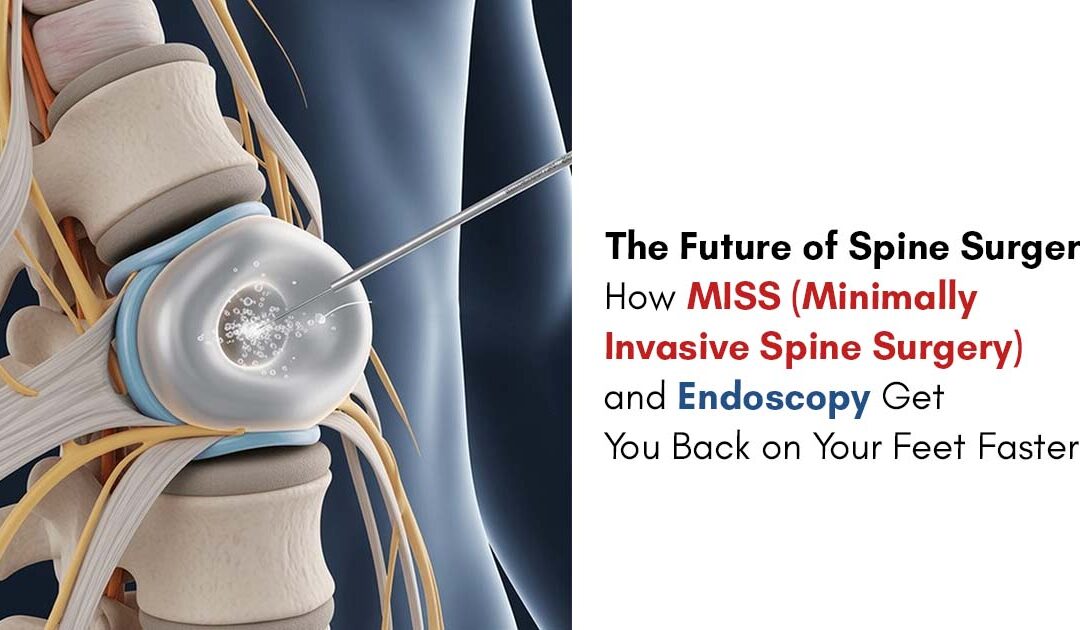
Endoscopic spine surgery is an advanced form of MISS that uses an extremely small incision, often less than 1 cm, and a tube-shaped endoscope equipped with a camera and microscopic instruments. Surgeons operate while watching high-resolution images on a monitor, allowing precise movements without disturbing surrounding structures.
Endoscopic spine surgery is especially effective for:
- Herniated discs
- Nerve compression
- Foraminal stenosis
- Sciatica
- Certain types of spinal cysts
Because the endoscope provides magnified visual clarity, surgeons can treat the problem with exceptional accuracy.
Why MISS and Endoscopy Are the Future of Spine Surgery
1. Smaller Incisions, Bigger Benefits
Traditional spine surgery often involves incisions that range from 5–10 cm or more. In contrast, MISS and endoscopic techniques require cuts as small as 0.5–2 cm. Smaller incisions mean:
- Less damage to muscles and soft tissue
- Reduced blood loss
- Minimal scarring
- Lower risk of infection
These advantages make the overall experience far less stressful for patients.
2. Faster Recovery and Quicker Return to Normal Life
One of the biggest benefits of MISS and endoscopic surgery is the dramatically reduced recovery time.
Many patients:
- Walk within a few hours after surgery
- Go home the same day or the next day
- Resume daily activities in a few days
- Return to work far sooner than after open surgery
This fast recovery is particularly valuable for working professionals, athletes, and elderly patients who want to avoid prolonged downtime.
3. Less Pain After Surgery
Since MISS and endoscopic techniques minimize muscle cutting and tissue disruption, patients typically experience far less postoperative pain. As a result:
- Pain medication requirements are significantly lower
- The risk of narcotic dependence decreases
- Mobility improves sooner
A quicker, less painful recovery allows patients to focus on rehabilitation and overall spine health.
4. High Precision for Better Outcomes
Both MISS and endoscopic spine surgery rely heavily on cutting-edge imaging technologies like:
- Fluoroscopy
- Intraoperative navigation
- High-definition endoscopic cameras
- Surgical microscopes
This ensures that surgeons can work with great accuracy—even in tight or delicate spaces. The precision reduces the chances of complications and improves overall surgical outcomes.
5. Lower Risk of Complications
Because these techniques are less invasive, patients have:
- Reduced infection risk
- Lower chances of blood clots
- Minimal muscle damage
- Fewer postoperative complications
This makes MISS and endoscopic procedures especially suitable for patients who have other health issues or may not tolerate traditional open surgery well.
Who Can Benefit from MISS and Endoscopic Spine Surgery?
These modern techniques are ideal for many common spine conditions, including:
- Herniated or slipped discs
- Sciatica or leg pain due to nerve compression
- Spinal stenosis (narrowing of the spinal canal)
- Spondylolisthesis (slipped vertebra)
- Degenerative disc disease
- Spinal instability that requires fusion
- Compression fractures
Not every condition can be treated with MISS, but many cases that previously required open surgery can now be done minimally invasively.
The best way to know whether you’re a candidate is through a consultation with a spine specialist who can evaluate your MRI, symptoms, and overall health.
What to Expect During the Procedure
While each surgery is different, the general steps of MISS or endoscopic spine surgery include:
- Small incisions are made over the affected area.
- Tubular retractors or an endoscope are inserted to create a working channel.
- The surgeon uses tiny instruments to remove disc fragments, decompress nerves, or stabilize the spine.
- Real-time imaging guides the entire procedure.
- The incision is closed with minimal sutures or glue.
Most procedures take 45-90 minutes, depending on complexity.
Recovery: Getting Back on Your Feet Faster
Patients often notice immediate improvement in pain, especially leg pain from nerve compression. A typical recovery timeline may include:
- Same day: Walking with assistance
- 1-3 days: Discharge and light activities
- 1-2 weeks: Return to office or desk work
- 4-6 weeks: Begin physiotherapy
- 6-12 weeks: Full return to normal life
Because muscles heal faster, long-term outcomes are often better and the risk of chronic back pain is reduced.
The Bottom Line: A Better, Safer, Faster Way to Heal
The future of spine surgery is already here, and it’s minimally invasive. MISS and endoscopic techniques allow patients to experience:
- Smaller incisions
- Less pain
- Minimal hospital stay
- Faster recovery
- Safer outcomes
- A quicker return to daily activities
These innovations represent a major step forward in spine care, offering hope, comfort, and confidence to anyone struggling with chronic back or neck pain.
If you’ve been delaying spine surgery due to fear of long recovery or complications, it may be time to explore minimally invasive and endoscopic options with a qualified spine surgeon.
Modern spine care is no longer about big cuts, it’s about big results with the smallest approach.