Imagine an intense bolt of pain that feels electric that might be triggered by something as harmless as brushing your teeth or a bit of wind hitting your cheek. That’s what life is like for people with trigeminal neuralgia which is a rare nerve disorder famous for turning even small, everyday moments into sudden agony.
Trigeminal neuralgia (TN) is a chronic pain condition that affects the trigeminal nerve, which carries sensation from your face to your brain. It causes sudden, severe facial pain, often described as stabbing or electric shock-like. Even mild stimulation—like brushing your teeth or feeling a breeze—can trigger intense pain.
Characteristics of Trigeminal Neuralgia:
- Sudden, severe facial pain which is Sharp, stabbing, or electric-shock-like pain, Often comes in bursts or attacks lasting seconds to a couple of minutes.
- Pain is usually on only one side of the face
- Pain triggered by everyday activities like Chewing, speaking, brushing teeth, shaving, washing your face, or even a breeze.
- Pain episodes may come and go, with symptom-free periods in between but overtime, attacks may become more frequent and intense.
- Typically felt in the jaw, cheek, teeth, gums, or lips. Less commonly it affects the eyes or forehead.
- Sometimes, constant dull ache or burning sensation is felt between sharper episodes (known as “atypical TN”).
- There are no other neurological symptoms like numbness or muscle weakness.
Who are affected?
- Global prevalence of TN is estimated at 4–13 cases per 100,000 people per year.
- Usually affects people over 50 years old, but can occur at any age.
- Maximum incidence is seen between 50–70 years age group.
- More commonly seen in women than men (approximately 2:1 ratio).
What goes wrong?
In simple terms, a nerve can be imagined to be like an electrical wire. Just like a wire, it has the signal conducting part (neuron) and an insulation (myelin). If this insulation (myelin) gets damaged, the wire starts short-circuiting, sending uncontrolled sparks (pain signals) even when it shouldn’t.
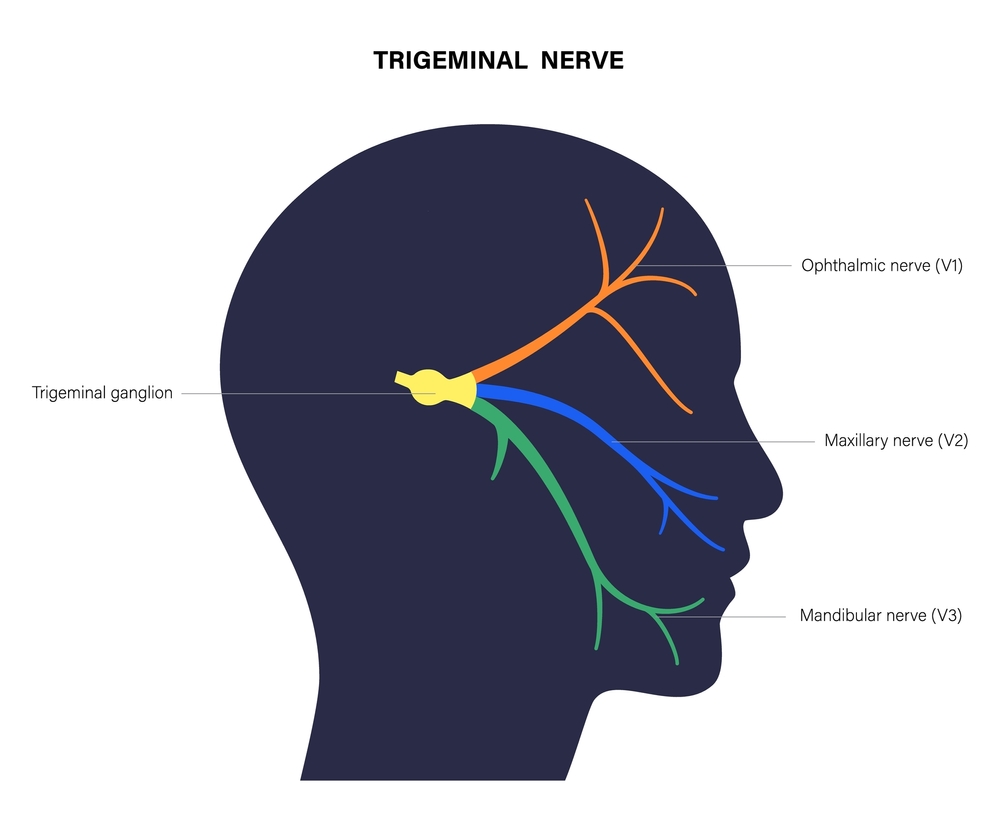
The Trigeminal Nerve originates in the brain and it has 3 branches:
- Ophthalmic (V1): forehead, eye
- Maxillary (V2): cheek, upper lip
- Mandibular (V3): jaw, lower lip
This nerve helps you feel touch, temperature, and pain in your face.
Usually, a blood vessel (commonly an artery) presses against this nerve where it connects to the brainstem. This constant pressure wears off the insulation around the nerve (myelin), and the nerve becomes overactive and too sensitive. So, even a mild sensory stimulus triggers a severe reaction
Other less common Causes:
- Multiple Sclerosis (MS) – an autoimmune condition which damages myelin directly.
- Tumors pressing on the nerve.
- Arteriovenous malformations
- Nerve injury or trauma.
- Stroke
- Trigeminal neuralgia also affects older patients more commonly and there is a possibility that nerve degeneration with age could play a role in its causation
- Sometimes, no clear cause is found (idiopathic TN).
Diagnosis and Treatment
A doctor may diagnose trigeminal neuralgia mostly clinically – based on your symptoms and history – but certain tests are done to confirm the cause and rule out other conditions.
MRI of the brain is the main diagnostic tool.
A neurologist or neurosurgeon might order an MRI brain with the following special sequences
- 3D FIESTA/CISS – for nerve-vessel anatomy
- MRA (TOF or contrast) – to detect vascular loop
- T2-Weighted 3D imaging – to visualize CSF and nerve integrity
- T1-Weighted with contrast – to rule out tumors or MS
Thorough neurological examination, ENT and dental check-ups are needed to rule-out other causes of facial pain.
Treatment Options:
Treatment focuses on reducing nerve irritation and controlling pain.
- Medications are the First-Line Treatment. Anticonvulsant medications are used to reduce nerve signal hypersensitivity
| Carbamazepine | Most commonly prescribed; very effective |
| Oxcarbazepine | Fewer side effects than carbamazepine |
| Gabapentin | Good for chronic burning pain or atypical TN |
| Baclofen | Muscle relaxant, sometimes added |
| Lamotrigine | Used when others don’t work or cause side effects |
- Surgical: If the patient is not responding to medicines or needs very high dose of medications or is unable to tolerate the medications and its side effects.
- Microvascular Decompression (MVD) is the most effective long-term solution where the Surgeon places a cushion between the offending vessel and the nerve, thereby removing the compression of the nerve.
- Radiofrequency Rhizotomy uses Heat to ablate the pain sensitive part of the nerve and block pain.
- Gamma Knife Radiosurgery where focused radiation damages the nerve to reduce pain signals.
Hence, Trigeminal neuralgia is treated by a multi-modal regimen involving pharmacologic management, lifestyle modification, and, in some cases, surgery.
If you are experiencing symptoms of trigeminal neuralgia, visit a healthcare provider today.